
Offshore project details
Wind Turbines
Navitus Bay will use horizontal axis turbines, the most commonly used kind of turbine. They consist of a tall tower, a fan-like rotor, a generator, a controller and other components. Each turbine will most likely have three blades and be painted a light grey colour. They will also have lights and markings on them so they can be seen clearly by marine vessels.
As Navitus Bay is still in the planning stage, no final decisions have been taken about the height, number and type of turbines or the distance of the wind park from the shore. Renewable energy technology is developing and improving at a rapid pace and will, undoubtedly, change further by the time the project reaches construction stage in 2017. Including a range of turbine sizes, heights and quantities is known as the ‘Rochdale Envelope’ and is a well-established approach to planning consent for offshore wind farms in the UK.
As it is not possible to define the model of turbine at this stage, Navitus Bay is considering turbines with an installed capacity of between 5MW and 8 MW. The turbines will, in principle, be set out in a regular, grid pattern - generally orientated such that the longest distance between turbines is in line with the prevailing wind direction (downwind). There will be a minimum of 756 metres between each one.
The final choice of turbine type and supplier will follow the project's Final Investment Decision – the point at which the funding of the project is finalised – in early 2017.
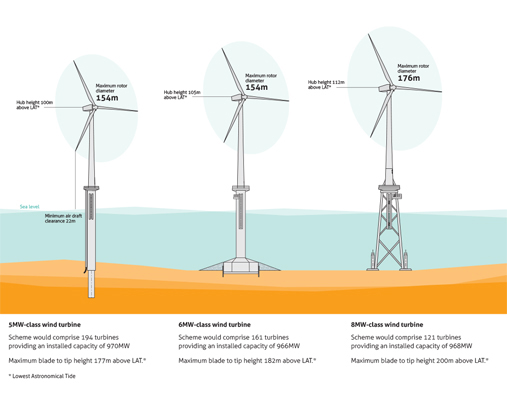
Range of potential turbine types
Click on image to expand
Due to the complex nature of the project and the potential for significant future technological advancement in the timeframe of the development, Navitus Bay originally consulted on three different wind farm configurations based on a range of turbine options between 3.6MW and 9MW.
In response to feedback from members of the public seeking greater clarity on the proposals, in December 2012 Navitus Bay decided to narrow the options to between 5MW and 8MW. In light of the most recent boundary change (February 2014) the maximum number of turbines will be 194, based on the use of 5MW turbines. The highest tip height above sea level will be 200 metres as opposed to the 210 metres that was originally proposed (pre December 2012) and the rotor diameter is 176 metres as opposed to 180 metres.
Foundation options
Navitus Bay has undertaken a preliminary engineering study in order to identify suitable foundation options. At this stage, a number of options are potentially suitable and the following designs will be included within the Rochdale Envelope:
- Steel monopile
- Concrete gravity base
- Space frame structures
The final decision will be based on a range of factors, including water depth; tidal, wind and wave conditions; logistical practicalities; commercial factors; ease of construction and installation; and the type and size of turbine chosen.
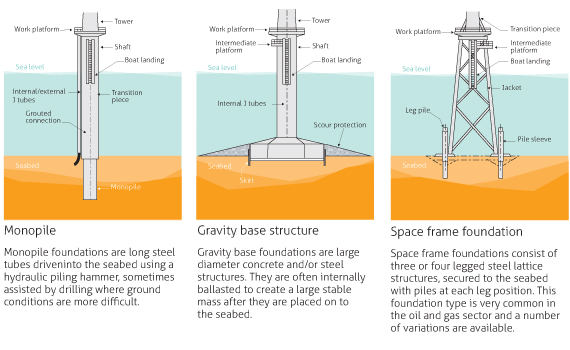
Range of potential foundation types
Click on image to expand
Offshore substations
There would be up to three platforms for electricity substations. The primary function of the offshore substation is to collect the electricity generated by the wind turbines and transform it from medium voltage to high voltage so that the power can be exported to the shore. The total height of the substation is likely to be up to 50 metres above sea level and would be marked to protect navigational safety in a similar way to the turbines. The exact locations would be determined during the detailed layout and design phase of the project and after further seabed investigations. The locations would provide the shortest distance to shore for the export cabling and the least complicated cabling configuration.
Meteorological mast
A meteorological mast (met mast) will be installed to collect reliable and representative wind data which will be used to inform the design of the Navitus Bay Wind Park and to provide more accurate estimates of the energy it could produce.
The mast would be a steel lattice structure up to a maximum of 120m high above Lowest Astronomical Tide (LAT) and could continue to provide information throughout the lifetime of the wind park.
Navitus Bay currently has consent for the installation of a met mast located outside the development area. It is considering applying for a location within the development area, although only one met mast will be built.
Usually a mast includes a monopile foundation, a lattice tower, equipment for taking various measurements, navigational aids and aviation lighting so it can be seen clearly from both the air and sea.


